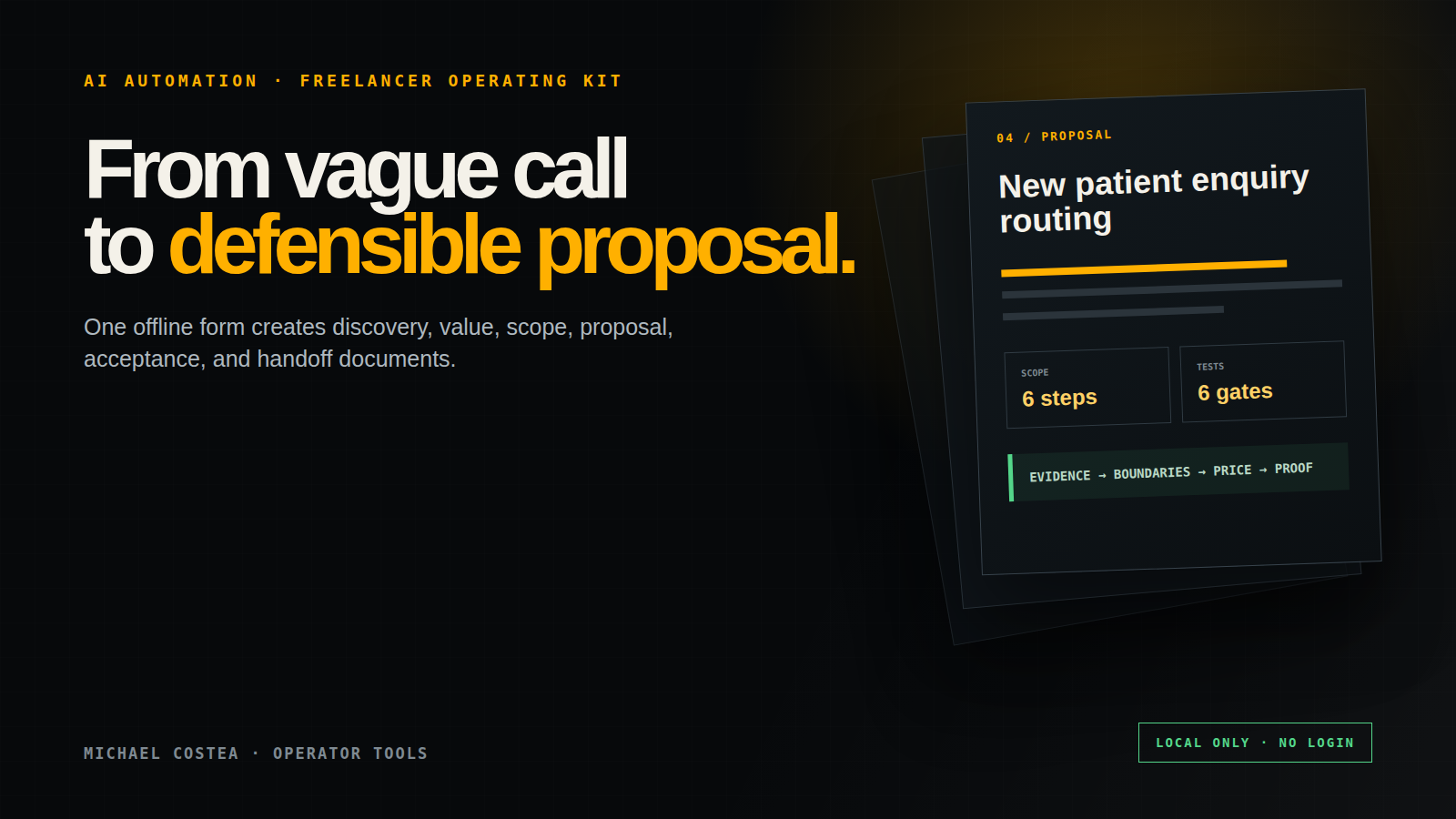
A proposal is only as stable as the scope underneath it.
Automation projects drift when the discovery notes, price, exclusions, success criteria and handoff live in separate documents. Requirements change. New stakeholders arrive. A workflow that “looks right” may still fail on permissions, duplicates, exceptions, or ownership.
This free structure keeps the buyer outcome, workflow boundary, value assumptions, acceptance evidence and change process in one reviewable scope before implementation starts.
One-page AI automation scope of work.
Replace bracketed prompts with verified discovery facts. Delete irrelevant sections. Keep uncertainty visible rather than writing around it.
# AI Automation Scope of Work

## 1. Client outcome
**Client:** [name / organisation]
**Workflow owner:** [person responsible after handoff]
**Decision owner:** [person who approves scope and changes]
**Business outcome:** [observable operational result]
**Current pain:** [delay, rework, missed follow-up, data entry, exception handling]

## 2. Current process and trigger
**Trigger:** [event that starts the current workflow]
**Current process:**
1. [current step]
2. [current step]
3. [current step]

**Current systems:** [n8n / Make.com / Zapier / CRM / inbox / forms / database]
**Current volume:** [occurrences per week or month]
**Current manual time:** [minutes per occurrence]
**Known failure points:** [missing data, duplicates, approvals, access, exceptions]

## 3. Included workflow and systems
The project includes:
1. [validated input or event]
2. [workflow action]
3. [human approval where required]
4. [write or notification]
5. [audit evidence / observability]

**Included systems:** [exact platforms and accounts]
**Inputs:** [required fields, formats and source]
**Outputs:** [record, notification, draft, status or report]
**Human review:** [who reviews what, and when]
**Error owner:** [person/team responsible for failed runs]

## 4. Explicit exclusions
The project does not include:
- [additional workflows not named above]
- [historical data cleanup or migration]
- [legal, tax, compliance or policy decisions]
- [unapproved autonomous decisions]
- [source-system data quality remediation]
- [new vendor subscriptions or usage charges unless listed]
- [support after the stated support window]

Anything outside the included workflow requires written change control.

## 5. Client responsibilities
The client provides:
- authorised access using least privilege;
- representative test data without unnecessary personal information;
- a decision owner and workflow owner;
- timely review of scope, security, privacy and policy obligations;
- source-system documentation and platform limits;
- acceptance evidence and final approval;
- credential rotation or revocation after handoff where required.

Delays or missing dependencies may change timing and price through written change control.

## 6. Value assumptions
**Weekly occurrences:** [number]
**Minutes per occurrence:** [number]
**Loaded hourly cost:** [currency and amount]
**Recoverable share:** [0–100%; the portion realistically avoidable]
**Confidence factor:** [0–100%; evidence strength]
**Setup cost:** [amount]
**Recurring solution cost:** [amount per month]

manual_hours = minutes × weekly_occurrences × 4.33 ÷ 60
risk_adjusted_hours = manual_hours × recoverable_share × confidence
monthly_value = risk_adjusted_hours × loaded_hourly_cost
net_monthly_value = monthly_value − recurring_solution_cost

If net monthly value is zero or negative: rescope before proposal.
These figures are scenarios, not guaranteed savings, revenue, ROI or headcount reduction.

## 7. Acceptance criteria
| Test | Input / condition | Expected result | Evidence | Owner | Status |
|---|---|---|---|---|---|
| Happy path | [valid representative input] | [expected output and timing] | [run ID / record / screenshot] | [owner] | Pending |
| Missing field | [required value absent] | [clear failure; no silent write] | [error record] | [owner] | Pending |
| Duplicate / replay | [same event repeated] | [idempotent or safely flagged] | [audit log] | [owner] | Pending |
| Permission failure | [access denied / expired] | [safe stop and alert] | [error + alert] | [owner] | Pending |
| Human approval | [approval required] | [no final action before approval] | [approval record] | [owner] | Pending |
| Exception path | [downstream system unavailable] | [retry / queue / recovery behavior] | [recovery evidence] | [owner] | Pending |

Acceptance requires all mandatory tests to pass or a written exception approved by the decision owner.

## 8. Delivery, handoff and support
**Deliverables:** [workflow, documentation, configuration export, test evidence]
**Target timing:** [estimate subject to dependencies]
**Handoff owner:** [client owner]
**Credential handling:** [least privilege, storage, rotation, revocation]
**Observability:** [logs, alerts, run history, failure visibility]
**Support window:** [duration and included support]
**Recovery:** [how the workflow is paused, retried, restored or disabled]

## 9. Price and payment
**Setup price:** [amount and currency]
**Recurring cost:** [amount, currency and billing owner]
**Payment schedule:** [deposit / milestone / completion]
**Third-party costs:** [platform, AI, messaging, storage or vendor charges]

## 10. Change control
A requested change is outside scope when it adds a workflow, system, data source, output, stakeholder approval, migration, policy requirement, acceptance condition or support obligation not listed above.

For each change:
1. describe the request and reason;
2. record impact on price, timing, risk and acceptance tests;
3. obtain written approval from the decision owner;
4. update the scope and test plan before implementation.

## 11. Approval
**Client decision owner:** [name]
**Provider:** [name]
**Scope approved:** [yes / no]
**Date:** [date]
**Open assumptions / exceptions:** [list]
“Working” needs an observable pass condition.
A useful acceptance row links a specific condition to an expected result, evidence and owner. This makes failures discussable before they become support arguments.
| Test | Expected result | Evidence | Owner |
|---|---|---|---|
| Valid enquiry | One CRM record and one review draft; no duplicate | Run ID plus CRM record | Provider during testing |
| Missing consent | Safe stop; no outbound message | Error record plus zero-send check | Client workflow owner |
| Replay | Existing record reused or duplicate flagged | Audit log | Provider during testing |
| Expired access | Workflow stops and alerts the named owner | Failure log plus alert | Client workflow owner |
Review before you send or sign.
Validate client facts, platform limits, privacy duties, security controls, pricing, contract terms, tax treatment, professional obligations and final commitments. Do not place secrets or unnecessary personal data into project files.
Move from one free scope to the complete offline workflow.
When the scope, proposal, value scenario, acceptance plan and handoff must agree, the paid kit generates all six from one discovery form. Inspect the full fictional sample before buying.
Open fictional sample Inspect the full kit Get launch price — US$3